Impact
E2SCALA didn’t wait to get off the ground, to begin making a difference. Here are some of our pilot projects, already underway!
2022
Cristina Lorenzo-Velazquez (Puerto Rico) from NC State presents her research on spatial correlation in ground motion in Ecuador. Cristina also attended the 2022 Latin American and Caribbean Seismological Commission Conference in Quito, Ecuador (October 2-6) during her visit.

2024
Resonant Column and Torsional Shear Workshop in El Salvador; led by E2SCALA Student Ambassador David Barba Galdamez (El Salvador)
A 5-day workshop was held at the Universidad Centroamericana “José Simeón Cañas” – UCA (El Salvador) from July 1-5, 2024. Its main goal was to train UCA’s faculty members, technicians and undergraduate students in the use of Resonant Column and Torsional Shear (RCTS) Apparatus. The workshop consisted of presentations about the theoretical basis of the resonant column test and the dynamic properties of soils; in-depth discussions; and hands-on training. Five undergraduate students, two faculty members, and two laboratory technicians attended the workshop. The workshop contributed to the development of the technical skills necessary for future research actiities focused on characterizing the dynamic properties (i.e., strain-dependent modulus and damping at small strains) of Salvadoran soil.


2025
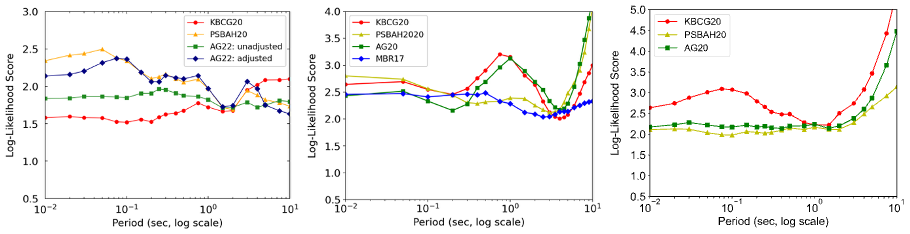
Nicolas Bastias (Chile) from Universidad de Concepción : An Updated Review of Ground Motion Flatfiles in the Chilean Subduction Zone (Bastias et al. SSA 2025)
Nicolas Bastias (Chile) from Universidad de Concepción was supported to present his research in collaboration with E2SCALA partners Dr. Gonzalo Montalva (Chile), Dr. Renmin Pretell (Peru), and Dr. Ashly Cabas (Venezuela) at the 2025 Seismological Society of America Annual Conference: An Updated Review of Ground Motion Flatfiles in the Chilean Subduction Zone (Bastias et al. SSA 2025)

Building a low-cost seismometer with freshmen undergraduate students at NC State
As part of the E101 – Introduction to Engineering and Problem Solving course, freshman undergraduate students at NC State design and build a low-cost self-sufficient seismometer (including signal-conditioning, recording and display systems) for use in educational and citizen science activities. This hands-on-activity introduced students to fundamental concepts of earthquake engineering and seismology, raising awareness of the importance of seismic risk analysis in the central and eastern United States (CEUS). During the project, the students put core design concepts and problem solving skills into practice while learning how to work successfully in an interdisciplinary team. E2SCALA Student Ambassador David Barba Galdamez (El Salvador) and Dr. Ashly Cabas (Venezuela) mentored the students through the process.

Partnerships
CRESCENT-E2SCALA PROJECT:
The main goal of this work was to assess the extent to which selected ground motion models (GMMs) provide accurate estimates of medianground motions (GMs) and their associated variability in the Cascadia Subduction Zone (CSZ). Selected GMMs were evaluated using three complementary approaches, including comparisons of probability density functions of the observed and predicted GMs, the total residual probabilistic scoring method (log-likelihood), and Sammon’s maps. The latter is a visualization technique that allows a better understanding of the underlying epistemic uncertainty of GMMs. Special emphasis on investigating how well the contributions from local geology are captured in three densely populated cities (Seattle in the CSZ, Lima in Peru and Concepcion in Chile) enabled recommendations for predicting GMs in megathrust tectonic environments.
Collaborators: Ashly Cabas (Venezuela), Gonzalo Montalva(Chile), and Renminn Pretell (Peru); all members of E2SCALA.
Deliverables: three graduate students were actively involved in this project, including Nicolas Bastias from Chile. PI Cabas created a video on the fundamentals of site response and Nicolas was supported to attend the 2025 Seismological Society of America Annual Meeting.